Sleep Smart
We highlight smart bedroom tech that helps you rest better and wake refreshed, all easily controlled with a tap or voice.
Disclosure: This post contains affiliate links. If you click through and make a purchase, we may receive a small commission at no extra cost to you This helps support the site & allows us to continue creating free smart home guides. Thank you!
GOOGLE NEST HUB (2nd GEN)
Quick Verdict: Is the Google Nest Hub (2nd Gen) Worth It for the Bedroom?
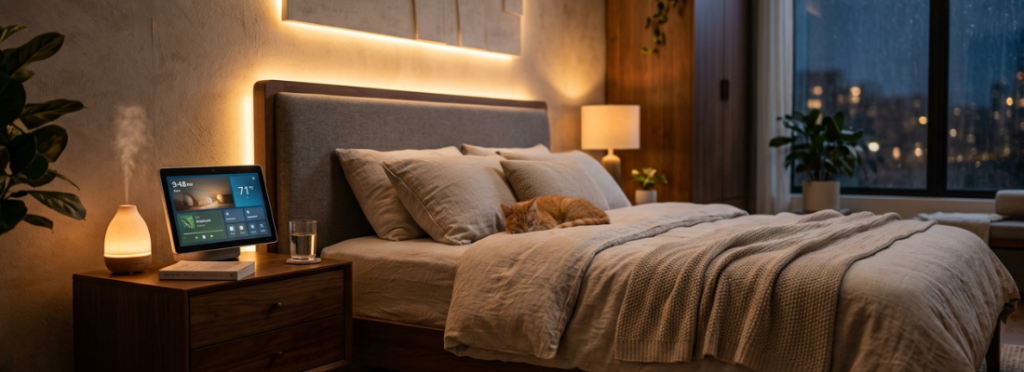
The Google Nest Hub (2nd Gen) is an essential acquisition for home automation enthusiasts seeking a non-wearable wellness solution. By utilizing Soli radar technology for sophisticated sleep tracking, it eliminates the need for uncomfortable watches or chest straps. If you prioritize privacy and actionable sleep data within a sleek, camera-free bedside interface, it is absolutely worth the investment.
How does the Nest Hub 2 track sleep without a camera?
The cornerstone of the Nest Hub’s bedroom utility is Motion Sense. Unlike traditional trackers, this device employs low-energy Soli radar to detect sub-millimeter movements. It monitors your breathing patterns, coughing, snoring, and even light changes in the room. This “contactless” approach is a significant milestone for the 2026 smart dwelling, providing high-fidelity sleep analytics while maintaining total visual privacy – as the device purposefully lacks a camera.
Is the Google Nest Hub easy to set up for Sleep Sensing?
Calibration is straightforward and takes less than five minutes via the Google Home app. You simply place the hub on your nightstand at mattress height and follow the on-screen prompts to “identify” your side of the bed. Once calibrated, the system operates autonomously; there are no buttons to press or apps to launch before sleep. The data synchronizes overnight, presenting a comprehensive wellness report the moment you wake up.
Top 3 Features and User Benefits
Soli-Powered Sleep Sensing: The primary benefit is frictionless wellness monitoring. It tracks sleep stages and respiratory health without the skin irritation or battery anxiety associated with wearable devices.
Sunrise Alarm & Bedtime Routines: This feature leverages circadian rhythm alignment. The screen gradually brightens to simulate a natural sunrise, while “Wind Down” routines automate your smart lights and play ambient noise to trigger melatonin production.
Integrated Thread & Matter Support: The benefit here is future-proofed connectivity. It acts as a controller for your entire bedroom ecosystem, allowing you to adjust Matter-enabled thermostats or smart blinds via voice or the “Home Control” dashboard.
Pros and Cons
Pros Cons Contactless Tracking: No wearables required for deep sleep analytics. Subscription Requirement: Advanced long-term sleep insights may require Fitbit Premium. Camera-Free Design: Ideal for the privacy-sensitive bedroom environment. Placement Sensitivity: Requires a specific height and angle to track accurately. Centralized Control: Intuitive dashboard for all Matter and Google Home devices.
Real-World Performance: A Day in the Life
Your morning begins not with a jarring buzz, but with the Nest Hub’s display slowly warming from deep orange to soft yellow. You wave your hand to snooze the alarm via “Gesture Control” without touching the device. Upon waking, a “Sleep Summary” appears, showing how your room’s temperature affected your REM cycle. During the day, it serves as a high-end digital photo frame. At night, as you say “Hey Google, goodnight,” it automatically locks the front door, dims your bedside lamps, and begins a guided breathing exercise.
Comparison: Google Nest Hub vs. Amazon Echo Show 8
While the Amazon Echo Show 8 is a powerful smart display, it is less suited for a dedicated “Wellness Bedroom” application. The Echo Show 8 includes a camera, which many enthusiasts find intrusive in a sleeping area, and it lacks the Soli radar required for contactless sleep sensing. For the specific goal of sleep optimization and privacy, the Google Nest Hub (2nd Gen) remains the superior architectural choice.
Expert Verdict: Which Smart Path is Yours?
Who this is for:
- Wellness Enthusiasts: Those who want to optimize their recovery and sleep hygiene using data-driven insights.
- Privacy-First Users: Anyone who wants a bedside smart display but refuses to have a camera in the bedroom.
- Google/Matter Users: Homeowners looking for a centralized hub to manage a multi-brand ecosystem.
Who should skip this:
- Audio Purists: If you are looking for room-filling, high-fidelity music, a dedicated speaker like the Nest Audio or Sonos Era 100 is a better fit.
- Living Room Users: For high-traffic areas, a larger screen with a camera (like the Nest Hub Max) is better for video calls.


Disclosure: This post contains affiliate links. If you click through and make a purchase, we may receive a small commission at no extra cost to you This helps support the site & allows us to continue creating free smart home guides. Thank you!
LIFX LUNA SMART LAMP (Matter 1.3)
Quick Verdict: Is the LIFX Luna Worth It for the Bedroom?
The LIFX Luna is the premier choice for enthusiasts seeking a wellness-focused bedroom. Its superior color depth and dedicated circadian lighting routines make it a powerful tool for improving sleep hygiene. If you want a Matter-compatible lamp that provides medical-grade color accuracy and seamless automation without a bridge, it is absolutely worth the investment.
Is the LIFX Luna easy to set up with Matter 1.3?
Setting up the LIFX Luna is notably faster than previous generations thanks to Matter over Wi-Fi integration. You no longer need to navigate proprietary pairing modes; simply scan the Matter code with your preferred app (Apple Home, Google Home, or Alexa). For bedroom users, the most significant benefit of Matter 1.3 is the increased reliability and local control – meaning your sunrise alarms will trigger even if your internet connection drops overnight.
Can the LIFX Luna truly improve your sleep cycle?
The Luna is engineered specifically for circadian synchronization. Unlike budget smart lamps, it offers an expansive white-light spectrum (1500K to 9000K). This allows the lamp to mimic the ultra-warm, amber tones of a sunset to trigger melatonin production at night, and crisp, blue-enriched light in the morning to suppress it. This automated shifting helps regulate your internal clock, making it much more than a simple “decor” item.
Top 3 Features and User Benefits
- Polychrome SuperColor Technology: Featuring 26 individually controllable zones, the Luna can blend multiple colors simultaneously. This creates soothing, moving gradients like “flame” or “cloud” effects that are far more relaxing for a bedroom than a static single color.
- Innovative Gesture & Button Control: The base includes four physical buttons, but the standout is the gesture sensing. You can dim the light with a simple hand wave, providing frictionless interaction when you are half-asleep and don’t want to fumble for a phone or voice command.
- 1000 Lumen High-Output: Despite its compact, oval form, it is bright enough to serve as a functional task light. You get versatile utility, transitioning from a powerful reading light to a dim, 1% glow that won’t disrupt your partner.
Pros and Cons
Pros Cons No Hub Required: Connects directly to Wi-Fi/Matter ecosystems. Higher Price Point: More expensive than standard RGB table lamps. Matter Binding: Can control other Matter devices directly from the base. Directional Lighting: The oval shape is best for wall-washing, not 360° light. Thread-Ready: Future-proofed with a built-in Thread radio.
Real-World Performance: A Day in the Life
Your day begins with a 15-minute “Sunrise” fade; the Luna transitions from a dim, deep red to a bright, 5000K daylight white, waking you naturally. During the day, it serves as a sleek piece of modern decor. As evening approaches, the “Circadian Mode” automatically removes blue light, shifting to a warm amber. When you’re ready for sleep, a simple hand gesture dims the lamp to 5%, and a press of the physical “Goodnight” button on the base triggers a Matter command to lock the front door and arm the security system.
Comparison: LIFX Luna vs. Philips Hue Gradient Signe
The Philips Hue Gradient Signe is a strong competitor in the premium “bedroom ambiance” space. While Hue offers excellent ecosystem stability, it typically requires a Hue Bridge for full functionality. The LIFX Luna wins on direct connectivity and brightness (1000 lumens vs Hue‘s lower tabletop output). Additionally, the Luna‘s physical buttons and gesture controls offer a level of tactile, bedside convenience that the purely app/voice-driven Signe lacks.
Expert Verdict: Which Smart Path is Yours?
Who this is for:
- Circadian Health Seekers: Those who want automated, science-backed lighting to improve sleep quality.
- Modern Minimalists: Users who want a powerful hub and light in one sleek, bridge-free package.
- Matter Adopters: Anyone building a 2026-standard ecosystem who values local, fast control.
Who should skip this:
- Basic Users: If you just need a simple light to see at night, a budget $20 smart bulb is more cost-effective.
- Stable-Hub Traditionalists: If you already have a massive Philips Hue ecosystem, staying within that bridge-based system may be easier.

Disclosure: This post contains affiliate links. If you click through and make a purchase, we may receive a small commission at no extra cost to you This helps support the site & allows us to continue creating free smart home guides. Thank you!
WITHINGS BODY SCAN – Connected WiFi Scale
Quick Verdict: Is the WITHINGS Body Scan Worth the Investment?
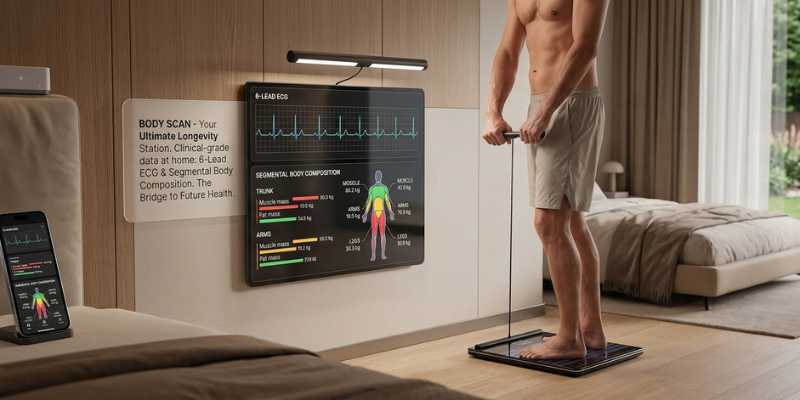
The WITHINGS Body Scan is the ultimate health station for home automation enthusiasts who demand clinical-grade data at home. By integrating a 6-lead ECG and segmental body composition, it replaces multiple medical devices. If you want a future-proof, comprehensive “longevity station” that bridges the gap between fitness and clinical health, it is absolutely worth the investment.
Is the WITHINGS Body Scan easy to set up for a smart home?
Setup is incredibly intuitive, even for a device with this level of complexity. Using the Withings App, the scale connects via Bluetooth for initial configuration and then switches to Wi-Fi for automatic, phone-free syncing. For enthusiasts, the real power lies in its Apple Health and Google Fit integration. Once linked, your body composition and cardiovascular data flow seamlessly into your primary health dashboard, allowing your smart home to adjust your wellness routines or lighting based on your morning recovery metrics.
Is the WITHINGS Body Scan worth it for a family of eight?
Yes, the scale is designed to be a centralized “health hub” for the entire household. It supports up to 8 independent user profiles and features automatic user recognition – you simply step on the scale (and hold the retractable handle), and it identifies you based on your unique body metrics. With specialized modes for Athletes, Pregnancy, and even Babies, it adapts its algorithms to provide accurate data for every family member, ensuring personalized health tracking for everyone under one roof.
Top 3 Features and User Benefits
Segmental Body Composition: Unlike standard scales that measure only from the feet, the Body Scan uses a retractable handle to measure your torso, arms, and legs independently. This allows you to identify fat/muscle imbalances and target specific areas in your fitness training.
6-Lead ECG & Vascular Age: This provides a comprehensive heart check-up. It can detect signs of Atrial Fibrillation (AFib) and estimate your “Vascular Age” relative to your peer group, acting as an early warning system for cardiovascular health.
Nerve Health Assessment: By measuring the sweat gland activity in your feet, the scale provides a Nerve Health Score. This is a breakthrough for home users, as it can help detect early signs of peripheral autonomic neuropathy, often related to stress or metabolic issues.
Pros and Cons
Pros Cons Hospital-Grade Metrics: Includes 6-lead ECG and segmental composition. Premium Price: One of the most expensive smart scales on the market. Rechargeable Battery: Lasts up to a year on a single USB-C charge. Subscription Model: Some advanced long-term insights require Withings+. Sleek Aesthetic: High-strength tempered glass and a vibrant color screen. Size: Larger footprint than basic scales due to the handle base.
Real-World Performance: A Day in the Life
Your morning starts by stepping onto the tempered glass platform. You pull up the retractable handle, and the vibrant color screen instantly displays your name and a localized weather report. Over the next 90 seconds, the scale performs a full scan–measuring everything from visceral fat to heart health. By the time you’ve finished brushing your teeth, the data has synced to the cloud. You open your app to see that your “Vascular Age” has improved, providing a data-driven boost of motivation before your morning workout even begins.
Comparison: WITHINGS Body Scan vs. Garmin Index S2
The Garmin Index S2 is a robust choice for athletes already deep in the Garmin Connect ecosystem. However, the WITHINGS Body Scan is the superior “Longevity Station.” While the Garmin tracks basic body composition and weight trends, it lacks the 6-lead ECG, handle-based segmental analysis, and nerve health tracking found in the Withings. If your goal is athletic performance tracking, Garmin is great; if your goal is a total clinical overview of your body’s health, Withings wins.
Expert Verdict: Which Smart Path is Yours?
Who this is for:
- Data-Driven Enthusiasts: Users who want the most precise, clinical-grade health markers available at home.
- Proactive Health Managers: Those focusing on heart health, metabolic trends, and long-term longevity.
- Modern Families: Large households that need independent, automatic tracking for multiple people.
Who should skip this:
- Minimalist Users: If you only care about your weight once a month, this level of data will be overwhelming.
- Budget-First Shoppers: There are much cheaper scales if you only require basic BMI and fat percentage estimates.
Smart Sleep
Smart bedroom devices blending comfort with seamless automation.
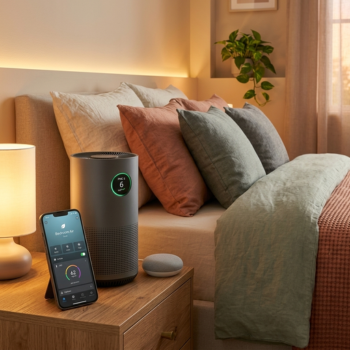
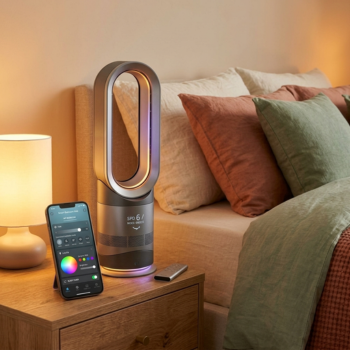
Upgrade your sleep sanctuary with a Smart Air Purifier, designed for total mobility and convenience. App-based controls let you manage your air quality from the office or the street, while Alexa and Google Assistant compatibility provide an effortless, voice-activated experience. For guaranteed results, always choose an AHAM Verifide® model, independently certified for superior air-cleaning performance and energy efficiency.
Tech Tip: Always check the voltage before purchasing; 120V models are intended for the US market only and require specific electrical infrastructure.
For total comfort and smart performance, a Smart Bedroom Fan is an essential 2026 upgrade. These versatile devices offer effortless control via app, voice (Alexa/Google), or remote, allowing you to manage everything from dynamic RGB lighting to specialized oscillation modes with a single command. The most advanced models feature an ‘Auto Mode’ sensor, which intelligently scales fan speeds up or down as your room’s temperature changes. It is a powerful, ‘set-and-forget’ addition that brings professional-grade air circulation and convenience to the contemporary smart home.
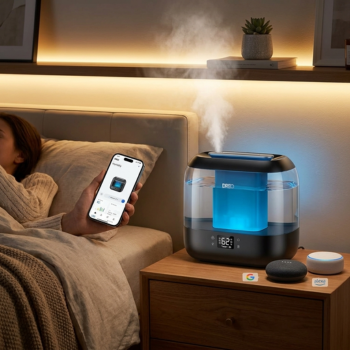
Achieve total climate control with a Smart Humidifier, featuring exact digital timers and enhanced sensing for automated humidity management. Whether you use the dedicated app or voice commands via Alexa and Google, you can adjust mist levels and ambient lighting without leaving your bed. These smart units are designed to auto-adjust to your ideal settings, while built-in status lights keep you informed of air conditions at a glance. With optional ‘clean mist’ and demineralization cartridges, these devices offer a healthier breathing experience with significantly reduced maintenance requirements.